
Reading Between the Lines
This story is supported by a grant from Shared Ecologies.
Translated and edited by Kamakshi Narayanan
School education and traditional wisdom are the two eyes of the people of the forests—
One opens our eyes to the outside world;
The other opens the eyes of a whole community.
When I was young, my mother tried to put me in a school in Prakasapuram, near Shenbaganur, with five other kids from my village, Bharati Anna Nagar (at the time it was not yet a village, but an area referred to as Bhootha Naachi Koil, after a temple in the area). As it was quite a distance from home, she enrolled me in the school’s hostel too. I hated the idea so much that I would not eat or go to class. Eventually Kattu Raja, Balanagu, Sumathi and the others, who hated the school and the hostel just as much, joined me and we all ran away—home! My mother then put me into a school in Perumalmalai, closer to home, back in the first grade—where I was until I got through the 10th standard.
I had studied till the 12th standard, but due to an unfortunate turn of domestic events I couldn’t write the exam; something I still want to do. Only if I get through the 12th can I potentially go to college. If I become a college graduate, my son and his contemporaries will be motivated to pursue higher studies, and the degree will also help me advocate for my people.


Dreams for a better education are handed down over generations. These two young Pazhaiyar children, six (left) and seven years old respectively, do not attend school (1). More Pazhaiayars are trying to avail of education: seen here, Suvitran, the author’s son (left) attends upper kindergarten Little Flower School in Perumalmalai, along with Yuvana, her niece, in first standard; the school is managed by priests inspired by Japanese teachings, as part of Bodhi Zendo, a Zen training centre (2). The author (right) is seen here with Muthu, a young boy who she was persuading to go to school, at the time, in Kombai Pallangi, a nearby village (3). Photos: handouts from Murugeshwari Balan.
For me, school became a doorway to understanding the laws of the land and the rights that belong to us. Many from the plains and the cities, like our own people in the hills, have suffered from the absence of education. Without it, one can easily be misled. Higher education enables us to exercise and protect these rights, as well as to remain on an equal footing with the world. If I had not learnt to read and write, I would not understand what government officials say about Forest Rights or recognise how land-grabbers use false boundaries to claim forest land. It was this realisation that made me continue my studies, and seek to pursue a college degree (or two!), and to claim my right to know and decide for myself.
‘Why should school education be subsidised for the poor?’ This was a question asked of K Kamaraj, chief minister of the then Madras State, now Tamil Nadu, in the 1950s. He replied, ‘Education is the only thing that can neither be stolen nor bought.’
Kamaraj was committed to bringing literacy within reach of severely marginalised communities. He understood that poor families often could not afford to send their children to school. For many parents, a day’s work by a child, however small the earning, meant food for the family. With this in mind, he introduced the Midday Meal Scheme, which ensured that every child who attended school received at least one free meal a day. Yet even such thoughtful planning had little impact on children from backward and tribal communities. For those of us living in the alais (large caves) and the forests, schooling was still seen as a luxury rather than a necessity; children could be working or helping in the forest, instead.
Yes, it’s certainly true that my parents never considered going to school themselves, but things began to change with my mother’s generation. With remarkable foresight, she would say, ‘Educating our children is the only way for our community to prosper.’ She enrolled both my sister and me in school, despite the financial strain it placed on her, and in doing so, she forged a new path for us to follow.

A postage stamp in the 1970s displays the image of K Kamaraj, then chief minister of what was then Madras State. Photo: Government of India (Open License).
A couple of centuries ago, only the Pazhaiyars and the Pulayars lived in the forests here. They did not consider that the sholas they lived in and shared with the wildlife were not owned by them! The Pazhaiyars of those days were engaged in gathering honey, digging for tubers like vallikkizhangu (a type of yam) and gathering other forest produce for their sustenance. My grandfather Marimuthu, often described in detail how, in the past, our people lived carefree, roaming between the rocks and streams. Yet, despite that freedom, poverty was a constant companion. We never settled in one village; instead, we lived as nomadic hunter-gatherers, moving through forests and glades. Back then, a small amount of paddy was the usual payment for grazing cows owned by nearby landowners. Even the 10 or 20 paise we earned from doing odd jobs was cherished.
In the late 1800s and early 1900s, when people from other communities came to settle on the same forest land and make a living, problems arose: the Pazhaiyars, uneducated and poor, made for an easily available, inexpensive workforce for both farm and house. Even little children were put to work. Earning a regular salary was an unheard-of concept, so the Pazhaiyars often resorted to ‘borrowing’ money from their landlords—an act that trapped them in a cycle of bonded labour.
A few left for nearby towns in the plains—Palani, Oddanchatram and Ayakudi—and found employment on the farms growing coconuts, guavas and bananas, or on large plantations. A similar story emerged here as well: usurious interest rates forced tribals, particularly the Pazhaiyars, into bondage with their landlords, which continued for generations. There is an area in Kavunji, on the route between Kodaikanal town and Palani, called BL Shed—short for Bonded Labour Shed—where crude sheds were built from the 1950s onwards to house generations of indentured Pazhaiyar workers.

Activist Thanraj (far left) hails from Theni. He is seen here with the young Pazhaiyar boy (second from left) whose education he is supporting, and members of the boy’s family. Photo: Murugeshwari Balan.
As recently as 2000, the late activist Siva Santha Kumar rescued a whole family from the cruelty of bonded labour. He documented this story in his book Forest Rights and Human Rights, which he had presented to me. He also spoke to me about this shortly before he passed away due to Covid—about the cruelty the tribals had to endure as bonded labour in the plantations of the hills. He often said, ‘Education is essential for the poor and downtrodden to uplift themselves.’
My grandmother Meena also once pointed out that ‘it is only when charity foundations such as Arogya Agam in Theni and the Institute for Self-Management came to work for the upliftment of our people that some understanding of the importance of schooling and education entered the minds of the Adivasis’. We, the Pazhaiyars, came to realise how much we had been marginalised and victimised as we slowly came into contact with the outside world and its stark realities. But even with all this help and greater awareness of the world beyond us, we have been able to get only the basic amenities and rights that are due to us—though that in itself is quite noteworthy!
Most of us, including me, have been to schools run by nuns in more inaccessible parts of the Palani Hills. Almost everyone in my age group has finished 10th standard; quite a few are college graduates, while there are a few post-graduates as well.

Rajesh (left) and Soman (right) are among a handful of post-graduates in the Pazhaiyar community. Rajesh, who has earned an MBA (Master of Business Administration), hails from Mannavanur and has worked as a Forest Department ranger. Soman,who has a Master’s in social work, hails from Moolaiyaaru and has worked in a managerial capacity with TADCO (Tamil Nadu Adi Dravidar Housing and Development Corporation, which addresses the socioeconomic conditions of Scheduled Caste and Scheduled Tribe communities in the state). Both are now members of their respective Grama Sabhas (village-level assemblies); they help fellow Pazhaiyars complete necessary paperwork and more. Photo: Murugeshwari Balan.
Now, with awareness among the people, most have graduated from high school and are aiming for college. My anni Kaleeswari (‘anni’ is sister-in-law, more specifically elder brother’s wife, but older woman friends may also be referred to by this name) has only studied up to the fifth standard, but her children have been to high school. Though her daughter, Akhila, did not pass her tenth-standard exams and is a daily-wage worker now, Kaleeswari is motivating her to finish school and pursue higher studies—maybe even to crack the UPSC (Union Public Service Commission) or IIT (Indian Institute of Technology)! I am reminded of the stellar example of our country’s president, Droupadi Murmu, who belongs to the indigenous community of the Santhals of Odisha: we have seen reports of how, only through her determination to get a college education, and hard work, she has risen to the highest office in the country.

President Droupadi Murmu, an adivasi from the Santhal community, is seen here meeting ITITI-Doon Sanskriti School students. Taking the position of President of India in 2022, Murmu is the first person from a tribal community to hold this office. Photo: Thapa Maverick.
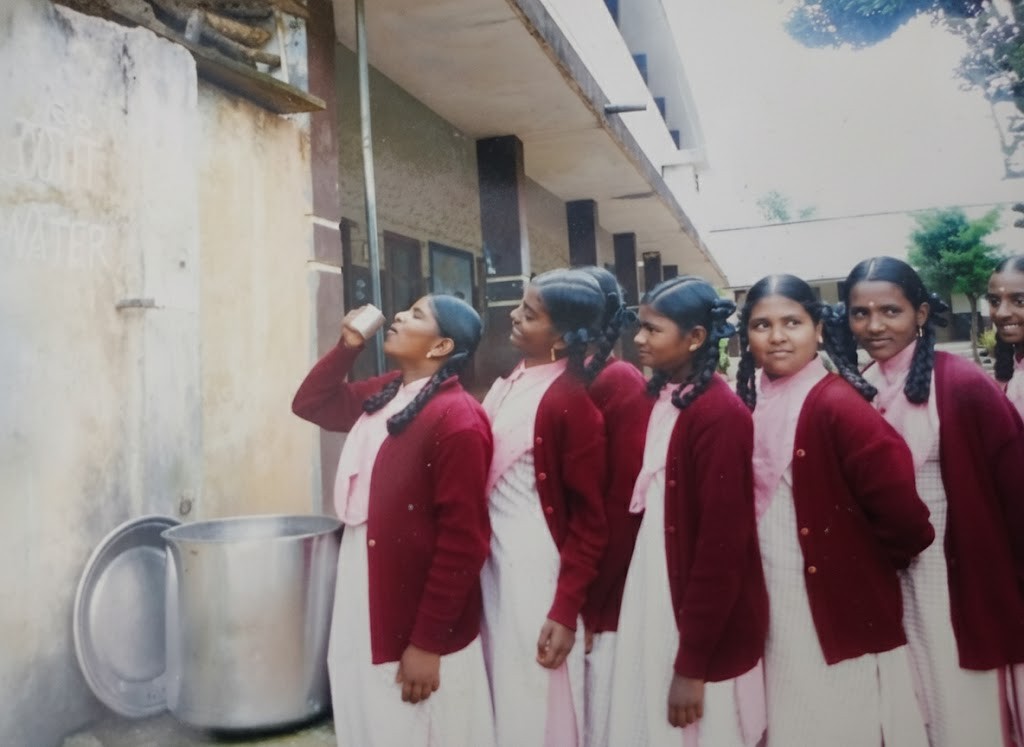
In recent years, the government has made efforts to bring tribal children into schools through scholarships. Getting caste or tribal certificates is still not easy in some parts of India, but we hope it will become simpler in time. Sending our children to school and then college feels more within reach for us now.
School education is different from learning from nature in the wild—one cannot replace the other, but they complement each other. The forest teaches us how to live with the land; education helps us face the systems that govern it. While modern education is essential, to forget our roots is to defy what our ancestors knew and held dear. Traditional knowledge nourishes the soul and reminds us of who we are, even as we engage with the modern world that is only now beginning to understand the wisdom our ancestors carried.


Let the children learn: A traditional Indian classroom (1); a government school in Palani town which the author visited; school children walk between a road and greenery, in Tamil Nadu (note: there are no Pazhaiyar children in these images). Photos: Yogabrata Chakraborty (1), Murugeshwari Balan (2), Saravan KM (3).
Our knowledge can benefit other communities as well. A culture and knowledge exchange is possible between communities. What would it take for children from the city to live with us as part of their curriculum or through outreach programs, to learn our ways of life?
I have heard that schools in Denmark and elsewhere in Europe have ‘forest schools’, where children between four and seven years old go into the woods, with adult supervision, to learn from what nature has to offer. We can do this here too, in the forests close by and on farms. Children learn quickly through experience, not rote. The fear that children might have of insects, animals and the wild can, over time, be replaced by familiarity and, in some instances, friendship. Without exposure to nature, city-bred children may not understand just how much climate change is driven by overconsumption, that rainfall in the hills and forests gives the cities drinking water, that reversing deforestation is urgent. And with exercise and fresh air, cooking for themselves with locally foraged food, and learning to clean up after themselves instead of littering, they can grow into better citizens.

Working on the move: The author works on her laptop while on a visit to the plains. When she is not writing articles about Pazhaiyars, she also likes to read novels like those of B Jeyamohan; the issue is getting access to books. Photo: handout from Murugeshwari Balan.
Art could also play a part: public art projects that showcase colourful paintings illustrating our way of life and our interactions with the flora and fauna of the Western Ghats will not only tell our stories to the outside world but also deepen the knowledge of our own children.
Writing about our people is something I have always wanted to do. And not in the way so many outsiders do, writing about our poverty and lack of formal education, as curiosities dressed in torn and dirty clothes, waiting to be observed! We have an identity, and in order to establish it, our people, customs and traditions need to be portrayed in their proper perspective and dignity, not only in Tamil. I want to be able to portray our people, our traditions and our culture with dignity, not only in Tamil but also eventually in English, so more people can see us as we really are.
