
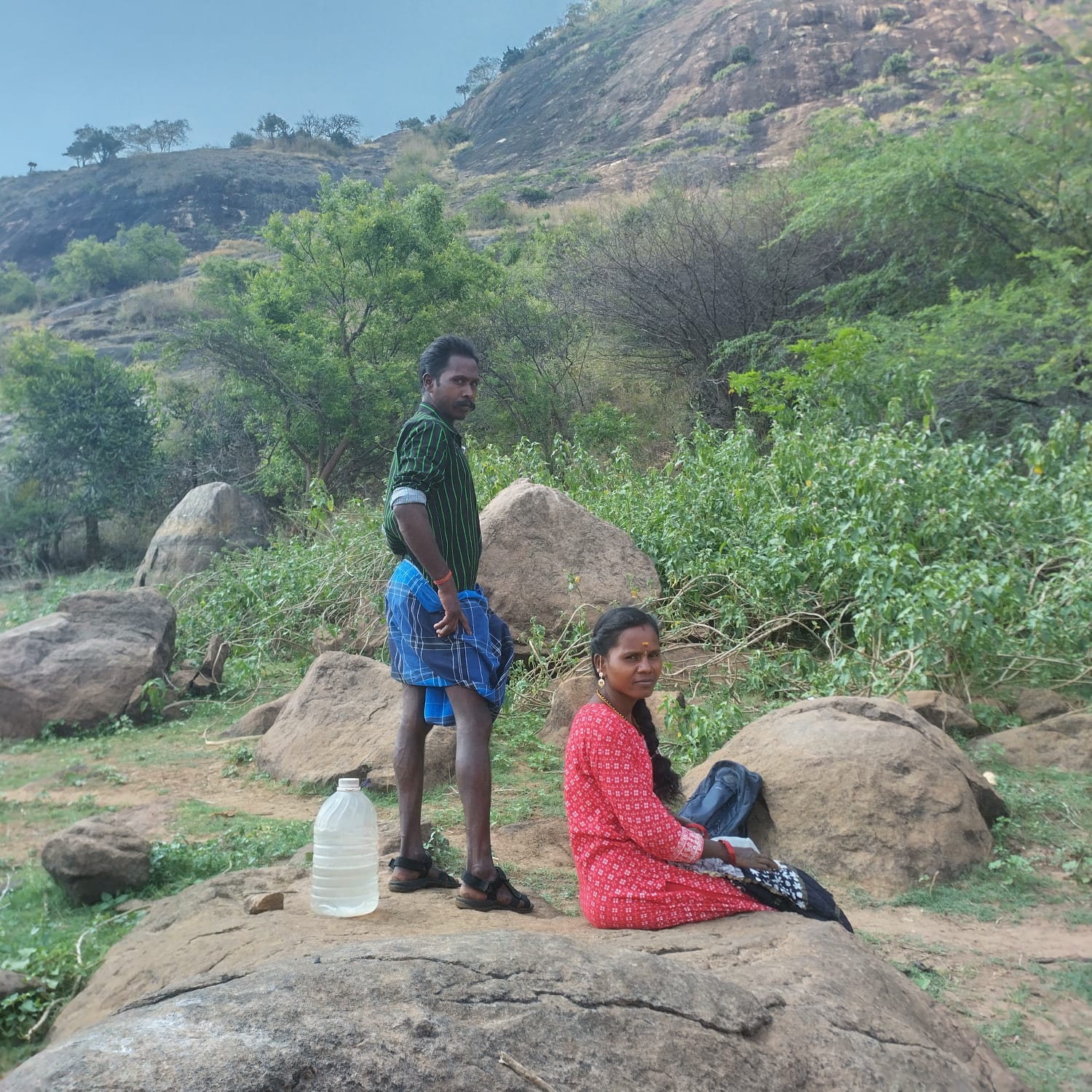
The Pazhaiyar Life: Then and Now
Translated and edited by Kamakshi Narayanan
For many centuries, the Pazhaiyars have been continuous inhabitants of the montane forests of the Western Ghats, from Theni in the west to Pazhani in the east—they are even mentioned in the Silappathigaaram, a Tamizh epic dating back to 2 CE. Their name is said to be derived from ‘Pazhaiyar’ meaning ‘the ancients’, which, in course of time, was corrupted to Paliyar.
They have depended on forest produce all their lives, subsisting on vegetables and fruits like green bananas, jackfruit, valli kizhangu (white yam) and a variety of other yams, as well as small animals of the forest, which they hunt. They also consume various varieties of millets grown on hill slopes and, of course, honey. Knowledge of the forests is ingrained in their body and spirit, rather than laboriously learnt. They never had to work for others—unlike today, when they have to work at plantations and farms for daily wages, sometimes even as indentured labour.
Hollows found among the rocks that line the streams and sometimes large caves and rock formations by the sides of streams—called alai—were living spaces; small cottages were built with stones piled together. The walls were plastered with mud mixed with kadukkai (myrobalan—fruit-bearing species with varying uses) and slaked lime, thatched with palm fronds and thailapul (a variety of lemongrass), and the doors were made of kidugu—plaited banana leaves and bark.
They lived as joint families, two or three generations together in an alai. My mother, Kaleeshwari, was the second child of her parents, Subramani and Maya. She and her siblings—Vannakkili, Thambikkutti, Kanniyammaal and Paappaaththi—all grew up together. Uncles and aunts from both sides of the family, along with their children, were also accommodated.
Goats and cows were reared. The men would gather honey, hunt small wild animals for meat and skin (for food and drums, respectively), grow crops like tapioca, yams, bananas and millets, gather mushrooms, and cultivate herbs like galangal, kasturi manjal, and other forest produce for their family. Though women did go into the forests to work, young mothers did not normally venture in, due to the responsibilities that come with rearing babies. It was a carefree, innocent life—children growing up happily, climbing trees, frolicking in the clear, herb-scented waters of the brooks, all the while learning about and being one with the forest.
Editor’s note: ‘Palayar’ is how the people of this community refer to themselves now. The consonants L (the hard L) and the zh are interchangeable frequently, especially in conversational Tamil. ‘Palayaa’ is when a Palayan is being called.

The Song of the Pazhaiyars
In the little kurinji flower, the honey beads up… Aey-lay-lo…
In which flower does the honey bead up? It beads up in the Siru Kurinji pu…
Watch the honey flow—divine* Palayaa… Aey-lay-lo… Aey-lay-lo…
I am Murugeshwaari, first child of Kaleeshwari, and a proud daughter of the Pazhaiyar community. Our lives in the olden days were far removed from the fast-paced city life you are all accustomed to.
Come—I will take you back 30 or 40 years, to when my mother, Kaleeshwari, was a young girl—when there was no electricity, and no mobile phone either!
Kaleeshwari’s Younger Days
As a young girl, Kaleeshwari, like everyone else in the family, would get up before sunrise, bathe in the nearby stream with her cousins and siblings, bring firewood for cooking and help prepare the morning meal. She would take the yams and tubers gathered by the boys the previous day, roast them over the fire, get her younger siblings to pick the bird’s eye chillies and raw mangoes or naarangaai (limes) from the trees nearby, and grind it all for chutney. Another little girl would have roasted the coffee beans and powdered in the mortar just outside the alai, and she would then boil the black coffee for everyone.
Since all the housework was carried out under the watchful eyes of the elders, traditional methods and recipes continued. Food was served directly on the rocks of the alai, without using plates, and everybody ate together. Pots cleaned, clothes washed and dried—housework was easy and quick as everybody pitched in.

When the chores were done, all the womenfolk and kids would go into the nearby forest areas, returning in time to prepare the evening meal. Women usually went deep into the forests with the men only if they were gathering honey, but they would take their little ones into nearby areas to harvest fruits and vegetables from the small patches of land they cultivated. There was no lunch as such, but if the kids were hungry, they would forage for fruits like hill guavas, dates, jackfruit and edible fruit such as thalanaar ( whose leaves are crushed by hand and used as shampoo) singuttaan and valukkai. The boys would have gone with the older men to hunt small animals, fish or help cut and fetch firewood.
Rainy weather meant the cooking was done within the alai; on bright days the family cooked outside. Since all the necessary ingredients, like the bird’s eye chillies, wild coriander and pirandai (veld grape) were brought in fresh daily, there was no need for a pantry. Dinner was usually any millet pounded in the mortar near the Alai, or occasionally wild rice, small animals—like the udumbu (monitor lizard) or the alungu (pangolin)—and fish or crabs from the nearby streams, cooked in a gravy of chillies, hill garlic, wild coriander and small tomatoes. As always, everybody ate together, the food served on the rock surface while there was still light.

Water mixed with erukku (giant milkweed) and vasambu (sweet flag) would be lightly sprinkled on the alai floor to prevent insects from entering. Palm fronds or eucalyptus leaves would be spread and covered with jute matting to sleep on; babies and young children slept with their mothers, using old saris for extra warmth. Kids would gather around their older relatives for stories of the forests—of the spirits and gods who inhabit them—creating a strong bond. These were stories they would, in turn, pass on to their own children. Fires would be lit at the entrance of the alai to keep predators out and to provide warmth during the rainy season—a warm and cosy atmosphere for all the children to gather around and listen to traditional tales like ‘The Elephant That Was Born to a Paliyan’ or ‘The Little Dove’, or stories about the gods—‘Nagamma’, ‘The Nava Kannigal’, ‘The Nine Young Girls’: all of which would keep them enthralled.
The elders would also infuse forest lore into bedtime tales, explaining why the karungaali (Ceylon ebony) and potti trees are venerated, and how their ancestors who have passed enter these and other such trees and warn the Pazhaiyars of lurking dangers. Our people would collect fallen twigs or branches from these trees and bring them to be kept at the altar at home; they would worship them on Tuesdays and Fridays (considered auspicious days), burning wild incense and camphor.
Under no condition would any of the trees that are venerated be cut. The children would avidly listen to tales about the avinji trees that grow on escarpments and bloom in the months of July and August, whose blooms are brought home to be worshipped with a brimming pot of water. It was also customary to keep or bury the bark or small branches of black or white etti (strychnine) in the four corners of the house, and also to bury some under the main entrance door, to ward off evil. The Pazhaiyars were very keen on protecting pregnant women and babies from dark forces. Twigs of black or white etti, leaves of vasambu and seer pachchilai (rue) were tied to the string worn around the waist of little kids’ waist strings.


The Pazhaiyar use all of the bounties of Nature. Seen above (1-3): potti pazham, avinji flower and moram flowers.
Singing their traditional songs—‘Namma Aaththaa —engadee porathu… Odi vaangadee kanneengala… Aey-lae-lo…’ (Will we glimpse our Mother? Where, Sister, can we go? Come quickly, little sisters… Aey-lae-lo)—joyfully splashing in the clear, herb-scented waters of the brooks, using local herbs like kasthuri manjal (wild turmeric) and thalai naar, eating fresh, seasonal food, the Pazhaiyars grew up healthy and contented, living in natural cave spaces and mud huts close to rivers and streams.
When Kaleeshwari came of age, she moved to a mud hut close to her parents’ alai; she lived there for nearly a year, along with other girls of her age. After some months, she was given turmeric and vibhuti (sacred ash) to wear on her forehead before she rejoined her clan in the alai. Her marriage happened a year after this, to a Pazhaiyar boy. In our community, the prospective groom comes to live with the girl at her parents’ home till they are officially married—and sometimes even after that. Mutual compatibility is considered very important. Marriages are not elaborate affairs—even the thaali (the marriage mangalsutra) is a simple string of karugamani (black beads), and some would even wear a tapioca vine. If there was any sort of disagreement between the couple (which rarely happened), divorce was allowed with the consent of the parents, and the girl was allowed to remarry. Widow remarriage was also prevalent—often to the deceased husband’s brother or close relative. Women had full freedom in all respects. After all, our deity Bhootha Naachchi, is a woman!
As Kaleeshwari did not conceive even ten years after marriage, she divorced her husband by mutual consent and with the approval of her elders. Her remarriage to another Pazhaiyar man, Balan, happened after a couple of years, while they lived in her father’s alai. They moved to Pazhani to work on a coconut estate. She returned to her father’s alai for the birth of both me and my younger sister, Sadaiyammal. We later returned to our own village, Bhootha Naachchi Kovil.
Kaleeshwari’s Life Now
Wanting their two daughters to have a life more suited to the fast-changing world, Kaleeshwari and Balan decided to return to the hills; they worked hard at various plantations nearby as well as in Pazhani, saving up for us, their children, to study in good government schools. Both of us were able to finish our tenth and twelfth standards only through their untiring work. They also saved enough money to build individual houses for each of us. Our village, Bhootha Naachchi Kovil, is now known as Bharathi Anna Nagar. Our parents are now daily wagers at a plantation near Perumal Malai, living in their own house.
Our family is living well—but that is not the case for many others. The Pazhaiyars once lived like kings in the montane forests but are now marginalised; having lost our livelihood as hunter-gatherers, as well as our right to farm for our own small needs, we have been forced to go out to work as labourers, sometimes bonded, at nearby plantations and small towns for daily wages. Many have turned to alcohol and drugs, losing touch with our ancestral way of life.
With the government having taken over the forest land, the tribals have been resettled. We have been given individual houses of brick and cement and now have to live as nuclear families, as these houses are small compared to the large alais we previously lived in. These so-called ‘modern‘ houses are confining and climatically unsuitable for a community that lived so close to Nature—the kids often fall ill, the elders miss the communal gatherings and the youth grow disconnected from our traditions and customs.
We Pazhaiyars do not cut and destroy forest trees, which is what plains people may think. Instead, as people of the Forest, we worship trees as our Guardians. Many species, like etti and karungaali, even the sticks of which we worship, are now very hard to find, having been cut and taken away by those with vested interests. The babbling brooks with herb-scented waters that the Pazhaiyars used for all their needs are not to be seen, and we are now dependent on the government to give us scarce piped water. The government has also stopped us from entering the forest—for two years now, even our yearly ritual of worshipping the avinji (or azhinji, like the Indian cranberry) flower has not been possible.
There is an even more deplorable situation—the accumulated garbage of plastic bags and bottles thrown out by the huge influx of tourists who come to enjoy the ‘pristine and green forests’. With inefficient waste management, our children fall ill frequently; the waste is like a river flowing through human settlements, the water hardly visible, posing an even bigger threat to wildlife. When gaur, deer and elephants eat the plastic along with food waste, they die. Human–animal conflict has also increased.
Looking at all this, we long for the good old days, free from external interference, to live as close to Nature as we have always been!
The Pazhaiyan who happily roamed free among the Alai,
Now chases the waves of data.
He who trusted the Rocks and the Soil of his birth,
Holds fast to the handphone.
Who can be blamed?… What can we blame? (Who can blame whom?)…
Times long past?
Or… today’s trends? Is it a boon or bane?…
ONLY TIME HAS THE ANSWER… to this query of the Pazhaiyan.
*‘Divine’ refers to the ancestors who have passed and are worshipped. Also: the names of five flowers—the ‘kanni pu’: Katta kurinji,( a variety of Kurinji), Kadamba, Moram (Sal), Naaval (Jamun) and Avinji —are used in every repetition; they are revered as untainted and untaintable.
