
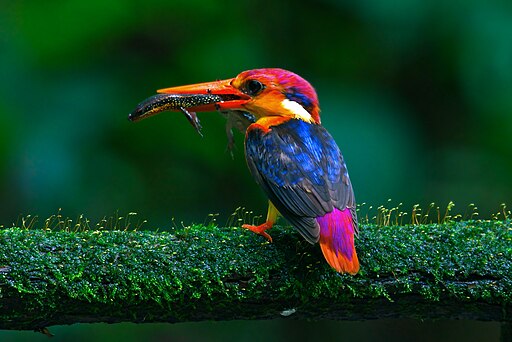
Chasing A Colour Bomb
One visit to Chiplun in Maharashtra, set deep in the Western Ghats, was enough for that monsoon morning to remain etched in memory—sharp and unforgettable, like light through the canopy. In 2018, I travelled there for the first time with one goal: to see the Oriental Dwarf Kingfisher (Ceyx erythaca) in the wild.
Alongside fellow birding enthusiasts, I followed Nandu Tambe, our local guide and forest watcher, into the rain-drenched forest. The trail was slick with mud, and the air thick with the scent of wet earth. After a quiet walk, we reached a known nesting site where a pair of kingfishers had been sighted.
The nest looked unremarkable, a small burrow in a muddy embankment beneath the twisted roots of an old tree above a trickling stream. But it held the promise of something rare.
We crouched behind foliage, breath held. Then, suddenly, a burst of colour broke the green monotony—plumage glowing burnt orange, violet, and electric blue. The bird hovered for a blink, then vanished into the tunnel. Its mate followed moments later.
No larger than a clenched fist, they radiated impossible colours in a world otherwise muted by rain and shadow. They darted in and out, carrying food for chicks hidden in darkness. Elusive, lightning-quick, gone almost before the eye could register them.
The forest held its breath. Leaves hung still. A tailorbird fussed nearby. I caught another flicker of crayon-box plumage before it disappeared again. Then, the forest closed over its secret, as if nothing had happened.
I stood there, stunned. Not lifting my camera, not moving, just holding the memory of a flash. Even in that fleeting glimpse, the bird felt like a memory , something already out of reach. The bird gives you just enough: a flash, a gasp and then vanishes, leaving wonder and absence.
On the way back, I noticed the stream we had followed had dwindled to a trickle. The forest floor was drier than expected. Banana plantations edged the forest. ‘The landscape has changed in just a few years,’ Nandu observed quietly. ‘Some patches cleared, others fenced.’
I didn’t expect to see the bird again. But in December 2021, at Goa’s Bhagwan Mahavir National Park, I caught another glimpse.
‘It appears for just a split second before it vanishes,’ said birder Ramesh Zarmekar, who runs Nature’s Nest homestay nearby. ‘That’s what makes it so precious, you barely have time to believe your eyes.’
He was right. Each encounter is fleeting, always unexpected, and deeply moving. Yet the more I glimpsed the bird, the more I noticed what had shifted around it: drier streams, encroaching plantations, and a growing hush where insects once buzzed.

Panvel is located in the foothills of the Sahyadri range in the Western Ghats, whose panorama can be seen in the first image above. Photo: Udayakumar PR.

It lies in Maharashtra’s Raigad district, the starting point for several trekking and tourist spots nearby, including Kalavantin and Karnala forts, and is lush and green, as can be seen in this image. Photo: Shiv’s fotografia.
Jewel of the Riparian Forests
The Oriental Dwarf Kingfisher, or ODKF, is among the most dazzling birds of India. Just 13 cm long, it has earned nicknames like ‘colour bomb’ and ‘jewel of the forest’. Shy, partial migrant, and elusive, it breeds in the monsoon, nesting in burrows dug into muddy banks along shaded jungle streams. It feeds on insects, spiders, crabs, frogs, lizards: prey tied intimately to clean streams and intact undergrowth. Its presence signals something vital: thriving riparian forests.
These forests are ecological arteries, stitching together soil, water, and canopy. Acting as borders between terrestrial and aquatic life, these forests are buffer zones, nurseries and sacred sites. Otters, freshwater crabs, and reptiles depend on them. For the ODKF, they are home.
The Vanishing Streams
The Western Ghats are one of the world’s eight ‘hottest hotspots’ of biological diversity. But the numbers tell a quieter, grimmer story.
The latest World Heritage Outlook report by the International Union for Conservation of Nature (IUCN), released on October 11, 2025, has classified the Western Ghats as an area of significant conservation concern. And, according to India’s State of Forest Report 2023, the Ghats lost about 58.22 sq km of forest cover between 2013 and 2023, much of it from riparian and semi-evergreen belts. Satellite data shows that between 1973 and 1995, dense forest shrank by 25.6%, while degraded forest area rose by 26%. Globally, 43 percent of natural World Heritage Sites now face climate-related threats, up from 33 percent in 2020, underscoring the need for stronger conservation measures in the Western Ghats.
More starkly, a 2022 study by MES Asmabi College reported that over 83% of riparian forests in the Western Ghats have been lost. That is not just tree loss. It is the loss of entire ecological processes: the insects the ODKF feeds on, the frogs whose calls mark the monsoon, the shaded tunnels where nests are dug.

Chiplun, located in Maharashtra’s Ratnagiri district, nestles between the Western Ghats and the Arabian Sea. Trekking, bird-watching and nearby coastal attractions draw many visitors, as well as the Vashishti River. Photo: Prasadgurav.
Nandu’s quiet observations in Chiplun—a drying stream, banana plantations edging inward—were part of just one small thread in a larger unraveling. Across the Western Ghats, the lifelines of riparian ecosystems are fraying. What once were shaded corridors of water, soil, and song are now disrupted by an array of pressures. The decline cannot be explained by a single cause; this is a mosaic of disruptions, each chiseling away at the hidden homes of birds like the Oriental Dwarf Kingfisher (ODKF).
Tourism, for instance, brings its own weight. Seeking the beauty and quiet of the forests, large scale resorts, illegal ad hoc constructions and heavy traffic mar the landscape. The increased footfall, has brought with it the debris of human encroachment: in Sindhudurg, Maharashtra, breeding banks are sometimes trampled by eager photographers, unaware that their footsteps collapse fragile burrows. The hush of the forest becomes a stage of shutters and voices and places meant to be experienced in silence, with attention to their fragility have become ‘hidden gems’ to be exploited for photographs.
But, infrastructure slices deeper. In Goa’s Mollem National Park, a railway doubling project, highway expansion, and transmission lines bisect streams and shred canopies. On paper it is progress; on the ground it is fragmentation. Dr. Pronoy Baidya, Scientist and Head of Division – Research at Arannya Environment Research Organisation, explains how such projects ripple outward: ‘Species like the ODKF are extremely mobile in the breeding season. While protected streams within the Ghats remain relatively safe, breeding zones outside take a hit from highways, mega housing projects, and even small check dams. Breeding pairs get displaced, losing precious time, and face new predators in altered landscapes… Unscientific modifications to flow channels damage underground aquifers and microhabitats that species like the ODKF depend on’.
Omkar Dharwadkar, President of the Goa Bird Conservation Network, identifies how these project have affected species, along with the ODKF, ‘Linear projects cut through habitats and… also cross streams that may have been nesting sites of the ODKF and even the Black-eared Kingfisher’.


Tamdi Falls (1) is located in Mollem National Park, seen here from overhead (2). Spread across 107 square kilometers in Goa, the park is home to towering deciduous trees, evergreen canopies, and a chorus of birds, Photos: Marcus (1), Joseph Assis Fernandes (2).
Elsewhere, the water itself is altered. Reservoirs in Maharashtra’s Konkan have drowned valleys, their signature streams buried or diverted. Dams change not just flow but timing, disrupting the breeding cycles of amphibians and insects, and with them, the prey base of birds. Take one species out of the loop and the entire ecosystem tilts in unexpected ways. Thousands of years of carefully evolved relationships rupture, leaving behind gaps that might not have the time to recover.


The Karli River originates in the Western Ghats, flowing through the Sindhudurg district before meeting the Arabian Sea near Malvan. The IUCN report warns that the Western Ghats’ ecological values are under threat and showing signs of decline, placing it in the second-most vulnerable category, just above ‘critical’. Photos: Rajesh Ghadigaonkar (1), Satyanadipally (2).
Mining tears apart another layer—iron ore extraction in Goa and bauxite mining in Maharashtra leave streams silted and rusty, choking aquatic life. Agriculture and plantations creep in too. Acacia and eucalyptus replace native trees, while banana plantations press against forest edges. Pesticide runoff slides unseen into streams, leaving waters too toxic for dragonflies or tadpoles.
As Dr. Baidya notes, ‘Invasive species encouraged by disturbed riparian systems displace native ones, leading to shifts in community structure and ecosystem function. The ODKF responds immediately to canopy loss, altered stream flow, or loss of soft embankments for nesting: when these microhabitats change, they abandon sites entirely’.
Each threat alone may seem small. Together, they create a quickening erasure.

The ODKF, also known as the three-toed kingfisher, favors dense vegetation near streams; seen here perching on various branches in Panvel before it eats a skink, it is an avid little predator. Photos: Preeti Swaminathan (1), Niraj Kasar (2).
Why One Bird Matters to the Many
The ODKF, dazzling in colour yet fleeting in its appearance, is more than a bird. It is an indicator species, its presence earmarking intact riparian belts. Its absence often signals ecological collapse.
Seasoned naturalist Adesh Shivkar points out the subtlety of this warning:
‘Its conservation status may appear secure but this bird remains ecologically significant. It plays a vital role in the ecosystem. And beyond that, its dazzling colours inspire not just photographers, but birders and researchers alike, drawing much-needed attention to the beauty and diversity of our natural world.’
He cautions that beneath the Least Concern label lies vulnerability: deforestation, riverbank modification, pesticides, and changing rainfall patterns are already altering its world. And he reminds us, ‘When the population of a single species is threatened, the impact ripples through the entire ecosystem. It is time we go beyond focusing on just one bird, such as the Oriental Dwarf Kingfisher, and recognise that every bird, every species, has an essential role to play in maintaining ecological balance’.
Protecting the ODKF means protecting soil, streams, insects, and amphibians. Its nesting burrows even aerate soil banks. Its hunger regulates insect populations. It is a thread in a wider web; tug it, and the fabric loosens. But, what would it mean to repair and restore these ecological tapestries?
People, Policy, and the Missing Links
Riparian ecosystems not only support birds and insects. They are also nourishing people who are part of this interdependence. In Goa and Konkan, traditional practices like Kulaghar plantations—mixed farms of cashew, areca, and spices—depend on aquifers and streams as lifelines. Springs are often protected through ritual and worship, ensuring their endurance. These human ecological practices have protected habitats and all the relationships they sustain. Humans are playing a role in conserving ecosystems: the urgency now lies in knowing how this was done and adapting them to restore landscapes. In practice, this requires collective efforts.
Policy has taken some steps. Goa’s State Biodiversity Board has championed wetland conservation, and village-level Biodiversity Management Committees (BMCs) mandated under the Biological Diversity Act (2002) have shown promise. The ecological knowledge from local communities has moved the government to declare rivers and other wetland areas as being protected.
Yet, gaps remain. As Dharwadkar observes, ‘Data, enforcement, community engagement, and political will—all are hurdles. Without them, projects that harm riparian ecosystems continue unchecked’. Dr. Baidya also underscores that conservation cannot succeed without ownership, ‘People are disengaging from natural systems. Without reconnecting them to streams and forests through advocacy, outreach, and education, no conservation strategy will succeed. Fortress conservation—a top-down approach—will fail. Instead, we need to integrate communities, their needs, and their aspirations’.
Experts converge on the need for immediate, local action: strengthening BMCs, involving plantation managers as stakeholders, integrating sacred groves with modern conservation. Awareness campaigns must translate ecological fragility into collective responsibility.
As Dr. Baidya concludes, ‘Protecting riparian habitats requires integrating traditional and scientific knowledge, and prioritising community-led strategies over unilateral ones. Only then can we secure species like the ODKF that depend on them.’
On paper, the ODKF is safe: Least Concern. In reality, its home—the riparian corridors of the Western Ghats—is critically endangered. This contradiction reveals the danger of our conservation gaze. If the ODKF vanishes, it won’t be because it was rare. It will be because its streams ran dry, its nesting banks eroded, the call of the frogs silenced. Because we thought a bird was safe while its world collapsed.
